
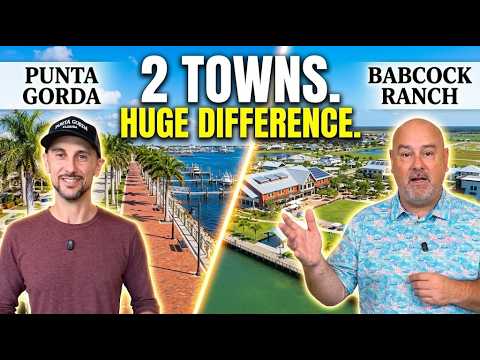
You have narrowed Southwest Florida down to two towns. One is brand new and planned from a blank sheet of paper. The other has more than a century of history on Charlotte Harbor. Which one fits your life?
We get some version of this question from buyers, sellers and people who just found the channel. So we laid it all out once, in depth: history, lifestyle, housing, money, healthcare, growth and hurricanes. This is a video post. The full transcript is below.
How are Babcock Ranch and Punta Gorda different at the core?
Almost every difference traces back to one fact. Babcock Ranch did not exist until 2018. Kitson & Partners planned it on more than 70,000 acres, most of it permanently preserved, and engineered the roads, fiber, schools, solar array and drainage together from day one. Punta Gorda dates to the late 1800s and grew the way towns grow, over more than a century, with brick streets, old live oaks and Mediterranean Revival architecture. Both are walkable, and both deliver a real sense of community. Babcock Ranch gets there through design: narrow streets, front porches and Founder's Square. Punta Gorda gets there through decades of the same families and shop owners. We cover more of the lifestyle side on the site.
Which town is better for boating and water access?
This is the biggest lifestyle dividing line, so we do not dance around it. Punta Gorda sits directly on Charlotte Harbor. Punta Gorda Isles is built around canals with private docks, and Laishley Marina puts you on the harbor downtown. Babcock Ranch does not offer that. It has lakes, a boat ramp, a fishing pier and Curry Creek for kayaking, but it is about 30 miles inland with no saltwater access to the Gulf. If direct Gulf access is non-negotiable, that is an early tiebreaker, and we would rather say so now than have you find out after you move.
Is Babcock Ranch all new construction?
No, and this is where many buyers get it wrong. Babcock Ranch has more than 23 neighborhoods, from Lake Timber with its simple fee structure, through gated neighborhoods like The Sanctuary and Palmetto Landing, up to golf and resort communities like Babcock National, Webb's Reserve and TerraWalk. Several early neighborhoods are complete and resale only, Edgewater and Lake Babcock among them, and Babcock National has a growing resale market. New neighborhoods also keep being added, so the list expands over time. Punta Gorda flips that. It is mainly an established resale market: historic bungalows, canal homes in Punta Gorda Isles and custom homes out in Burnt Store. In the video we explain which to pick if you want a builder warranty and your own finishes versus mature landscaping and character.
How do taxes, fees and insurance compare?
Both towns share Charlotte County's property tax structure, so the starting point is the same. The difference is in the extras. Most Babcock Ranch neighborhoods carry a CDD, a community development district fee that pays down the bonds that built the roads, utilities and amenities. It is not an HOA. The debt portion retires roughly 30 years after a home is built; the HOA covers ongoing items like landscaping and pools and does not go away. For current figures by neighborhood, see the HOA calculator. On insurance, Babcock Ranch sits about 30 feet above sea level, so many homes need no flood insurance and run lower premiums than canal-front property. Punta Gorda waterfront carries flood exposure and typically a higher bill. Get a quote on a specific address in each town. The video also covers Babcock Ranch's community enhancement fee at closing.
What about healthcare, growth and hurricanes?
Neither town has a full-service hospital inside it. Babcock Ranch has a TGH urgent care at The Shops at Yellow Pine, with hospitals in Fort Myers, Cape Coral or Port Charlotte about 30 to 40 minutes away. Punta Gorda's downtown hospital closed after the 2024 hurricane season; AdventHealth bought it in 2025 and opened an emergency department, while full hospitals in Port Charlotte are 15 to 20 minutes away. On growth, Babcock Ranch is early in its build-out and planned for around 20,000 homes, so new amenities keep arriving but some things still trail demand. Punta Gorda is largely built out, so change is slower and steadier. On storms, Babcock Ranch stayed powered through Hurricane Ian in 2022; Punta Gorda rebuilt after Charley in 2004. We lay out who fits where in the video.
Watch the full video
Watch the full breakdown for the detail behind every section, including the closing-cost items most people never hear about until it is too late.
Talk to Team John Garuti
This is a conversation, not a monologue. If you want to talk through your budget, must-haves and timeline, we can help you compare both towns and find the right home.
- Call or text: (239) 251-2371
- Email: info@babcockranchnewhomes.com
- Tour in person: schedule a tour
- Real resident talk: join the Moving to Babcock Ranch Facebook group
Thinking about Babcock Ranch?
Fifteen minutes with John's team: which neighborhood fits, which builder to trust, and what it really costs each month. No pressure, no pitch.
Get a free expert consultationor book a tourVideo transcript
Now, I get some version of this question, buyers, sellers, people who just found the channel. Should we be looking at Babcock Ranch or Punta Gorda? So, instead of answering it one buyer at a time, I'm going to lay out the real differences once on camera in as much depth as I possibly can. So you can actually decide for yourself.
This is going to be a long one. If you've been on the fence between these two towns or you're just starting out and curious what makes them so different, stick with me. I'm covering everything: the history, the lifestyle, the housing, the money, the health care, the hurricanes, all of it. By the end, you'll know exactly which one fits your life, or at least which questions to ask next.
Now, I want to be upfront about something before we get into it. We sell real estate in both of these towns. So I'm not here to talk you into one or the other. This is the real version, not a brochure version.
Let's start with the single biggest difference between these two towns, because almost everything else traces back to it. Babcock Ranch didn't exist until 2018. It's a master-planned community by Kitson & Partners on more than 70,000 acres, most of which is permanently preserved land. And construction of the town itself began in 2017. It's America's first solar-powered town, and it was built from a blank sheet of paper. The roads, the fiber internet, the schools, the solar array, the drainage system, all of it engineered together from day one instead of a pieced-together over decades feel.
Punta Gorda is the opposite kind of place entirely. It's a historic city on Charlotte Harbor that dates back to the late 1800s. It has old live oaks, brick-paved streets in the historic district, Mediterranean Revival architecture, and neighborhoods that people have lived in for generations. Nothing about it was planned as one unified vision. It grew the way real towns grow, organically over more than a century.
So, right out of the gate, you're choosing between a town engineered from scratch around a specific philosophy and a town with 100-plus years of actual history behind it. Neither one is better, but that one distinction is going to explain almost every difference that we talk about for the rest of this video.
In Babcock Ranch, everything centers on Founder's Square. It's the downtown district and it's got restaurants, shops, a fishing pier, a splash pad, a lakefront boardwalk, and events almost every week. It was designed from the beginning to be walkable from the surrounding neighborhoods: narrow streets, front porches, sidewalks everywhere, all built so that people would actually walk or bike into town instead of driving. And the town center keeps growing. B Street, a new walkable retail and residential plaza, is under construction right now across from Founder's Square. The Shops at Yellow Pine just opened as the town's largest commercial development to date with retailers like Marshalls, Publix, Five Below, Jersey Mike's, plus health care space.
Punta Gorda's version of a walkable downtown is its historic district and Fisherman's Village. Fisherman's Village alone has around 40 independently owned shops, galleries, and boutiques, plus waterfront dining and a marina. The Harborwalk connects Laishley Park to Fisherman's Village along Charlotte Harbor, and it's part of the 18-mile network of bike and pedestrian trails called the Punta Gorda Pathways. You can do most of a day in Punta Gorda, breakfast, shopping, a boat tour, dinner, without ever getting in a car.
Both towns are walkable. That part's actually similar. What's different is the character. Babcock Ranch's walkability is new and polished, built for a specific vision. Punta Gorda's walkability is decades in the making, with brick streets and buildings that have real history behind them.
Here's something that doesn't show up in any brochure, and it's honestly one of the things people bring up with me the most. In Babcock Ranch, I actually know my neighbor's name. That sounds small, but if you ever lived in a typical Florida subdivision, you know it isn't. People wave from their porches, kids ride bikes to Founder's Square or their school without an adult trailing behind them. You run into someone you know almost every single time you leave your house. Part of that is intentional design. Narrower streets, front porches facing the sidewalk instead of garages facing the street, everything built to put people in each other's path instead of driving past each other.
Punta Gorda has its own version of that closeness, but it comes from a completely different source. It's decades of the same families, the same shop owners, the same faces at the Saturday farmers market and the Thursday night Live After Five street events. Building relationships over years, not months. It's a town where people genuinely know each other because they've had time to.
So, if a real sense of community matters to you, and for a lot of my clients it's the number one thing, both towns do deliver. Babcock Ranch gets you there through design, Punta Gorda gets you there through history. Which one resonates with you probably says a lot about whether you want established or brand new.
This is probably the single biggest lifestyle dividing line between these two towns. So let's not dance around it. Punta Gorda sits directly on Charlotte Harbor. If keeping a boat behind your house, being on the water in 10 minutes, or living the classic Florida canal front life is a non-negotiable for you, Punta Gorda has decades of infrastructure built around exactly that. Neighborhoods like Punta Gorda Isles are built around canals with private docks. Laishley Marina puts you right on the harbor downtown. This is a genuine boating town, top to bottom.
Babcock Ranch does not offer that. It has lakes, a boat ramp, a fishing pier at Founder's Square, and access to Curry Creek for kayaking, but it's not a salt water harbor access, boat to the Gulf kind of town. It's about 30 miles inland. If direct Gulf access is something you're not willing to give up, that's an early and important tiebreaker, and I'd genuinely rather tell you that up front than have you discover it after you've already moved in.
Now, let's talk about what you're actually buying, because this is where the built from scratch versus historic town difference really shows up in the numbers. Babcock Ranch has more than 23 distinct neighborhoods at this point, and they break into a few clear tiers once you actually look at the numbers in our buyers guide. Lake Timber's the original neighborhood. It's walkable to Founder's Square, and it's the simplest fee structure in the entire town, since it has no sub HOA, just the master community HOA fee. From there, you move into gated neighborhoods with some amenities like the Sanctuary, Crescent Lakes, Palmetto Landing, each with its own pool and gated entry on top of the master amenities. And at the top end, you've got golf and resort-style communities like Babcock National, Webb's Reserve, and TerraWalk.
Here's the part that matters most if you're specifically hunting for resale, because this is where a lot of buyers get it completely wrong. Several of Babcock Ranch's earliest neighborhoods, and even some of the newer ones, have already sold a lot of homes or completely sold out, and new construction is not available, and resales are your only way there. Edgewater's complete, resale only. Lake Babcock, the same, complete, resale only. Babcock National, the golf community, has a meaningful and growing resale market as its original buyers have moved on. So, if someone tells you that Babcock Ranch is all new construction, that's simply not accurate anymore. There's a real, specific, and growing resale market, and I could point you to exactly which neighborhoods it's concentrated in.
Punta Gorda flips that entirely. You're primarily shopping in an established, resale-driven market. Historic bungalows near downtown, canal front homes in Punta Gorda Isles with private docks, and gated, more custom construction out in areas like Burnt Store. Home values across the greater Punta Gorda area run in the 300s on the low end and climb well beyond that on the water, with plenty of variation depending on the specific neighborhood, lot, and whether you're on a canal or you're inland.
And that's not even the full list on the Babcock Ranch side. New neighborhoods and hamlets are being added on a regular basis as the town continues to mature and continues to grow. So, by the time you're actually watching this, there may be a few more neighborhoods already in place. Now, that's actually kind of part of the appeal for a lot of my buyers. You're not choosing from a fixed, finished set of neighborhoods. You're choosing from a list that keeps expanding, which means there's a good chance that something new is always going to fit your exact budget and style even if nothing on today's list does.
On the Punta Gorda side, resale doesn't mean settle for. It often means character you simply can't get in a new construction. You've got original hardwood floors, mature oak canopies, screened lanais that have had 20 years to become someone's favorite room in the house. Punta Gorda Isles in particular is almost entirely a resale market at this point, since it was largely built out decades ago. And that's exactly why it commands a premium for the right buyer. There's no waiting on a builder schedule and no guessing what the landscaping will look like in 10 years. And that's because you can see it today.
So, the simplest way to put it: if you want brand new construction with a builder warranty and the ability to pick your finishes, Babcock Ranch may have a clear edge. If you want mature landscaping, architectural character, and an established neighborhood with decades of history, Punta Gorda has that in spades. I'll always confirm current pricing and availability with you directly before we go look at anything specific, since both markets move.
Let's talk money, because this is where I get the most questions, and it's where I most want to be precise instead of vague. Both towns sit in Charlotte County, so the county-level property tax structure is actually the same starting point for both. Charlotte County's median effective property tax rate runs right around 1 and 1/4% of the assessed value, and the median annual tax bill county-wide is a little over $3,000. Though your specific bill depends heavily on your assessed value, exemptions like homestead, and any special district assessments on your particular property.
That last part is where Babcock Ranch and Punta Gorda actually diverge. In Babcock Ranch, most neighborhoods carry a CDD, a community development district fee, on top of your regular property taxes. That fee pays down the bonds that built the roads, utilities, and amenities in the community, and it varies by neighborhood. So I'll always pull the specific CDD and HOA numbers for whatever neighborhood you're looking at, rather than quoting you a blanket figure here. In Punta Gorda, you're less likely to encounter a CDD in the older, established parts of the town, though HOA fees still apply in gated or platted communities like Punta Gorda Isles or Burnt Store.
Now, homeowner's insurance, and I want to be really transparent here, because it's one of the most consequential and most misunderstood costs in Southwest Florida right now. Florida as a whole has the highest average home insurance premiums in the country, and Southwest Florida specifically runs above the state average because of hurricane and flood exposure. Here's the honest nuance, though. Babcock Ranch sits roughly 30 miles inland and about 30 ft above sea level, which for many homes there means no flood insurance requirement and a meaningfully lower premium than coastal canal front property. Punta Gorda, especially waterfront and canal front homes, carry flood zone exposure that Babcock Ranch generally does not, which typically means a higher insurance bill for a comparable home.
This isn't a knock on Punta Gorda. Waterfront access is exactly why people choose it, and it comes with a real cost that's worth planning for. I strongly encourage anyone weighing out these two towns to get an actual insurance quote on a specific address in each before making a final decision, because the difference can be significant and it varies house by house.
One more thing on the CDD question, because I get this one constantly and it trips people up. A CDD is not the same thing as an HOA. The CDD is essentially a long-term loan that got the neighborhood's infrastructure built in the first place. The roads, the water, the sewer lines, the amenity centers, and you're paying for it over time, similar to a second smaller mortgage tied to a property. It's disclosed, it's public record, and the debt service portion retires roughly 30 years after the home is built, leaving just the ongoing operations and maintenance price. The HOA fee, on the other hand, is what covers the ongoing stuff. Landscaping and common areas, pool maintenance, that sort of thing. And that one doesn't go away.
Here's what our own buyers guide shows across the town right now. Every neighborhood pays into the master community association a little over $130 a month, and that covers a gigabyte per second of internet, community pools, tennis, pickleball courts, bocce ball courts, community pool, community patrol, and the town's lifestyle events calendar. On top of that, a neighborhood specific fee gets added depending on where you buy. In a neighborhood like Lake Timber or Lake Babcock Estates, there's no additional sub HOA at all. You're just paying that master fee. In a gated, amenity rich neighborhood like Sanctuary or Crescent Lakes, you're looking at somewhere in the low to mid 300s a month total. And in a golf or resort style community like Babcock National or Webb's Reserve, where the fee bundles in things like golf access and a clubhouse and sometimes building insurance and maintenance, total monthly fees can run anywhere from 600 to well over a thousand dollars depending on the home type.
None of these numbers are fixed forever. Fees are reviewed and adjusted periodically, so whatever the neighborhood you're seriously considering, I'll pull the current exact figure for that specific home before you make an offer.
And there's one more cost that almost nobody ever mentions until it's too late. And it's actually one of the most requested topics from my own viewers. What happens when you sell? Nearly every neighborhood in Babcock Ranch charges what's called a community enhancement fee at closing, equal to a quarter of 1% of the purchase price, on top of a typical one-time capital contribution or working capital fees that range anywhere from a few hundred dollars up to around $2,500 depending on the neighborhood. It's not enormous in the context of a home sale, but it's real money, it's specific to Babcock Ranch, and I'd rather you hear about it from me now before being surprised by it at the closing date.
So, let's talk logistics, because day-to-day life is more than just the town itself. Both towns are genuinely well-positioned relative to Punta Gorda Airport. This airport has exploded in recent years. It handled more than 2.2 million passengers in 2025 alone, an 18% jump over the previous record, and Allegiant currently flies more than 50 non-stop destinations out of PGD, with Sun Country adding seasonal service as well. A 50,000 square foot terminal expansion is underway now and expected to open in 2027. Practically speaking, that means direct flights to a huge number of cities without ever driving to Fort Myers or Tampa, and Punta Gorda residents are obviously closer to that airport day-to-day. Though Babcock Ranch is still a very manageable drive. For bigger connections, Southwest Florida International in Fort Myers is roughly 30 to 45 minutes from either town, depending on traffic and exactly where you live.
Within the towns themselves, the community experience is different by design. Babcock Ranch was built with golf cart paths threaded throughout the community, so a lot of daily errands, the pool, the pickleball courts, Publix, the farmers market, can happen without your car at all. Punta Gorda's historic downtown is similarly walkable once you get there, and a free trolley connects some of the major attractions, but if you're living out in Punta Gorda Isles or Burnt Store, you're probably driving into town like you would anywhere else.
If you care about having something to do on Tuesday night, Babcock Ranch's calendar centers on Founder's Square. Weekly live music, food truck Fridays, a Sunday farmers market, and a growing lineup of restaurants and shops as B Street and The Shops at Yellow Pine continue to open. It's still a young town, so the dining and event scene is expanding fast, but it's not yet as deep as an established downtown.
Punta Gorda, on the other hand, has had decades to build out its scene. Every Thursday evening, downtown hosts a Live After Five with live music, food trucks, and shops staying open late. There's a Saturday morning farmers market downtown year-round. Monthly art walks showcase local galleries, including the Visual Arts Center, and the festival calendar runs deep. Punta Gorda Restaurant Week, Oktoberfest, the Wine and Jazz Fest at Laishley Park, the Key Lime and Tropical Fest at Fisherman's Village, the Sullivan Street Craft Festival, and an annual chili festival, just to name a handful. If you want a genuine foodie town with dozens of independently owned restaurants and a packed event calendar, Punta Gorda currently has more volume, simply because it's had more time to build it.
Beyond the events themselves, Punta Gorda has real cultural infrastructure, too. The Blanchard House Museum and the Military Heritage Museum for history buffs, and a Visual Arts Center with rotating exhibits year-round. That's the kind of depth that only comes from having a town decades to accumulate it, and it's a fair advantage to acknowledge, even for someone like me who lives in Babcock Ranch.
I want to handle this section as honestly as possible, because healthcare access is real. It's a practical concern, especially for retirees. And I'd rather give you the full picture than a sales pitch. In Babcock Ranch, there's an urgent care, TGH. It's part of Tampa General's hospital network, located at The Shops at Yellow Pine, along with additional health and wellness space planned as the town grows. There is not a full-service hospital inside Babcock Ranch itself. For that level of care, residents typically drive toward the Lee Health System in Fort Myers or Cape Coral, or toward hospitals in Port Charlotte. Generally about a 30- to 40-minute drive, depending on exactly where you live in the community.
In Punta Gorda, the situation has actually shifted recently, and I think it's kind of important that you hear it from me and my team rather than find out after you've moved. The historic downtown hospital, most recently known as ShorePoint Health Punta Gorda, sustained damage during the 2024 hurricane season, and it closed. AdventHealth purchased the facility in 2025 and has opened a new emergency department there as what they've described as a first step, with the possibility of a full hospital and medical offices in future phases, depending on community need. In the meantime, full-service hospital care for Punta Gorda residents is available at facilities like HCA Florida Fawcett Hospital and ShorePoint Health Port Charlotte, both a short drive away in Port Charlotte, generally 15 to 20 minutes for most of Punta Gorda.
So, here's the honest bottom line on healthcare. Neither town currently has a full-service hospital sitting directly inside of it. Both rely on nearby facilities a short drive away. It's a wash in that sense, but it's exactly the kind of detail I'd rather walk through with you specifically, because your comfort level with that drive time might be different depending on your health situation or your family's needs.
If you're thinking long-term, 5 or 10 years out, these two towns are on very different trajectories, and that's worth factoring into your decision. Babcock Ranch is still early in its build-out. It's currently home to somewhere in the range of 12 to 15,000 residents with more than 5,000 homes sold, and it's planned to eventually reach around 20,000 homes and roughly 60,000 residents at full build-out, along with 6 million square feet of commercial space. It was recently ranked the fourth best-selling master-planned community in the entire country, up significantly year-over-year. Practically speaking, that means new neighborhoods, new retail, new amenities are going to keep arriving for years, which is exciting if you want to be part of a town's growth story, but it also means some things you'd want, more restaurants, more healthcare, more retail variety, are still catching up to demand.
Punta Gorda is kind of different in the trajectory entirely. It's a long-established, largely built-out city, so growth there tends to look more like redevelopment and infill and steady appreciation, rather than the kind of rapid ground-up expansion happening out in Babcock Ranch. That doesn't mean nothing changes. Downtown continues to see restaurants and businesses turn over, waterfront properties get renovated or rebuilt, and the harbor continues to draw investment. It's just a fundamentally slower, steadier kind of change than watching an entire new neighborhood get built from an empty field, which is exactly what you'll see happen in real time if you buy in Babcock Ranch today.
If you want a town that's already fully formed, with its character locked in and its best restaurants already discovered, that stability might be exactly what you're looking for. If you want to be in on the ground floor of something still being built, watching your property values benefit from that growth trajectory as amenities and commercial space continue to arrive, Babcock Ranch is that opportunity.
Now, I have to bring this up, because it's one of the first questions almost anyone asks me about moving to Southwest Florida in general, regardless of where. Babcock Ranch is powered by a 75-MW solar array, and resilience was baked into the decision from day one. Buried power lines, elevated home sites, and stormwater systems engineered specifically to handle major storms. It became nationally known for staying powered and largely undamaged through Hurricane Ian in 2022, which is a big part of why so many buyers ask about it by name.
Punta Gorda has its own very different hurricane story. It took a direct hit from Hurricane Charley back in 2004, and the town rebuilt substantially in the years since, with a lot of newer construction built to modern flood and building codes as a result. It also weathered more recent storms, including the 2024 hurricane season that affected the entire downtown hospital I mentioned earlier. Punta Gorda's resilience story is really about a historic town that has been tested more than once and has rebuilt and modernized each time.
Both towns have real, legitimate hurricane stories. Babcock Ranch's story is about a system engineered for resilience before a single storm ever tested it. Punta Gorda's is about a community that has weathered real storms and adapted. And I'd always recommend getting specific flood zone and insurance information for the exact address that you're considering in either town before making a final call.
So, let's bring this all together, because that's really what you came here for. Babcock Ranch fits you if you want brand new construction with a builder warranty, a walkable town built around sustainability and resilience, that genuine small town feeling where you actually know your neighbors' names, and you're comfortable trading direct boating access for lakes, trails, and a fishing pier. It also fits you if you want to be part of a town that's still growing, with new restaurants, retail, and amenities arriving regularly. And you skew towards wanting a younger, more family heavy community.
Punta Gorda fits you if waterfront and boating access are non-negotiable. If you want an established, walkable, historic downtown with real architecture and character, and 100-plus years of history. And if you'd rather move into a fully formed community with a deep dining and event scene already in place. It also tends to be a fit for buyers who lean more towards retirement or empty nest living.
Neither one is the right answer. They're genuinely built for different people at different stages of life with different priorities. That's exactly why I don't try to talk anyone into one or the other in a video like this. That's a conversation, not a monologue. And if Punta Gorda is calling your name after everything we just covered, go check out our other channel, Living in Punta Gorda, Florida. Links below, and we go just as deep on that town, too. If you're a little further along in your research, book a free strategy call with me or someone from the team at talkpuntagorda.co. That's dot co.
If you actually want to talk through which one fits your life, your budget, your must-haves, your timeline, book a free video call with our team at talkbabcockranch.com. Join our Moving to Babcock Ranch Facebook group, too, and take a look at our Google reviews while you're at it. We do have over 260 of them. Not ready for a call yet? Start browsing current listings and set up a price alert at homesforsalebabcockranch.com. Thanks for sticking with us through this whole thing. If you made it this far, you're clearly serious about this decision. We'll see you in the next one.