
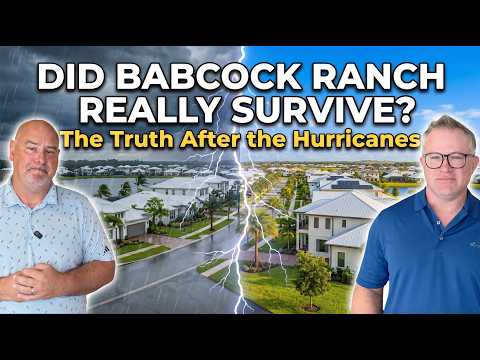
Everyone has heard the Hurricane Ian story. Babcock Ranch kept its power and stayed dry while much of Southwest Florida went dark for weeks. That was a few years ago, though, and one storm is not a track record.
If you are weighing a move here, storm resilience is probably one of your top three questions, right up there with cost and which builder to pick. This video post gives the honest answer: how the grid is built, what has happened since Ian, where the limits are, and what it means for insurance. The full transcript is below.
How is Babcock Ranch's power grid actually built?
First, a correction most people need. Babcock Ranch is not off the grid and it does not run on rooftop panels alone. The town is powered by more than 800,000 solar panels next door, built and operated by Florida Power & Light and paired with battery storage, so power keeps flowing after dark or under cloud. The bigger deal is underground. Every power line in town is buried, so there are no poles to snap and no overhead lines for a falling oak to pull down. The town also sits on elevated land with a storm water system designed to move water away from homes quickly. In the video we explain why the buried lines and the drainage do more of the heavy lifting in a hurricane than the solar panels that get the headlines.
Has Babcock Ranch held up in the storms since Ian?
This is the part most people skip. Babcock Ranch has been tested again since Ian, by the tropical systems and heavy rain events that have rolled through Southwest Florida in the seasons after. The pattern has held. Underground lines mean no widespread outages from downed poles. Elevated grading and storm water ponds mean streets clear fast instead of holding water for days. Ask anyone who has lived here through more than one season and you hear the same thing: the power stays on and you go about your week while other parts of the county deal with generators and spoiled refrigerators. We live here and have sold homes here through more than one hurricane season, so this is our own experience, not a brochure claim. The video walks through it.
Where does the storm resilience have limits?
Overselling this helps nobody, so here is the plain version. Babcock Ranch is not storm proof. No community in Florida is. The infrastructure cuts the common risks (outages, downed lines, street flooding) but it does not stop wind damage to roofs, screens, lanais or landscaping. Part of why flooding has not been an issue is location, not only engineering. This is inland Florida, with elevation relative to the coast, and that matters when you compare it with a coastal community. A working town grid also does not mean every household had zero interruptions in every scenario. It means the grid recovers fast and reliably. That is a real advantage, but it is not a reason to skip your own hurricane prep. We cover each of these limits in the video.
Does storm resilience lower your insurance in Babcock Ranch?
Buyers ask us this constantly. The honest answer is that it can help, but it is not a guaranteed discount. Rates are still driven heavily by your specific home, your roof age, your construction type and statewide insurance market conditions, not just the community you live in. What the resilience does do is reduce real-world risk and hassle: fewer days without power, less chance of a flooded street keeping you from work, and less stress every June through November. For many buyers relocating from out of state, that peace of mind is worth as much as a number on a premium. When we talk with buyers one on one, we cover storm performance and insurance neighborhood by neighborhood, alongside monthly costs and builder choice.
Watch the full video
Watch the full breakdown of how the grid is built and how it has performed since Ian.
Talk to Team John Garuti
If storm resilience is a top factor in your move, we can walk you through how each neighborhood has performed and what to expect on insurance.
- Call or text: (239) 251-2371
- Email: info@babcockranchnewhomes.com
- Tour in person: schedule a tour
- Real resident talk: join the Moving to Babcock Ranch Facebook group
Thinking about Babcock Ranch?
Fifteen minutes with John's team: which neighborhood fits, which builder to trust, and what it really costs each month. No pressure, no pitch.
Get a free expert consultationor book a tourVideo transcript
When Hurricane Ian hit, Babcock Ranch made national news for one reason. Not one home flooded, not one resident lost power, while the rest of Southwest Florida went dark for weeks. Now, that story is everywhere. Everybody's heard it, but that was Ian, and that was a few years ago.
So the real question, the one that nobody is actually answering, is what's happened every single storm season since. Did the solar town keep delivering, or was that one famous storm just a lucky break? We live here. We've sold homes here through more than just one hurricane season, and today we're going to give you the honest answer and the parts that nobody puts in the brochure.
Before we move on, head on over to talkbabcockranch.com and set up a video call if you're thinking about moving to Babcock Ranch. This is probably one of your top three questions, right up there with cost and what builder to pick, and it's going to help you and walk you through everything. So in the next few minutes, I'm going to walk you through exactly how the power grid is built, what's actually happened in the storms since Ian, where the system has real limits, and what this means for your insurance and your peace of mind if you're considering a home here.
First, let's clear something up, because most people get this wrong. Babcock Ranch isn't off the grid. It's not running on rooftop panels alone. The town is powered by over 800,000 solar panels right next door, built and operated by Florida Power & Light and paired with battery storage, so power keeps flowing even after the sun goes down or the clouds roll in.
The bigger deal isn't actually the solar panels. It's what's underneath the streets. Every power line in Babcock Ranch is buried. No telephone poles to snap, no overhead lines for a falling oak tree to rip down. That underground infrastructure is the real hero in a hurricane. Solar gets the headlines, but it's the buried lines and the storm water design that do most of the heavy lifting when the wind picks up.
The town was also built up, literally, on elevated land with a storm water system engineered to move water away from homes fast. That combination is why, during Ian, this town kept the lights on and stayed dry while flooding and outages crippled the surrounding region.
So that's the engineering. Sounds great on paper, but the real test is, does it actually hold up? Storm after storm, year after year. That's what I want to show you next. A link is in the description if you want our free buyers guide, but stick around, because the insurance numbers later in this video surprised almost everyone.
Let's talk about every storm since, because this is the part people skip. Babcock Ranch has been tested again and again, not just one headline storm, but the tropical systems and heavy rain events that have rolled through Southwest Florida in seasons after Ian. And the pattern has held. Underground lines mean no widespread outages from downed poles. Elevated grading and storm water ponds mean streets clear fast instead of holding water for days.
Residents here aren't bragging about a one-time miracle. Ask anyone who's lived here through more than one storm season and you'll hear the same thing. It's mind-blowing. The power stays on, you go about your week, while people in other parts of the county are dealing with generators and spoiled refrigerators. And that's really the headline. This isn't a one-hit story. It's a repeatable result, storm after storm.
Now, here's where I have to be straight with you, because overselling this helps nobody. Babcock Ranch is not storm proof. No community in Florida is. The infrastructure here dramatically reduces the common risk: outages, downed lines, street flooding. But it does not eliminate wind damage to roofs, screens, lanais, or landscaping.
It's also worth saying plainly that this is inland Florida, not coastal. Part of why flooding hasn't been a major issue here isn't only the engineering, it's also the location and the elevation relative to the coast. That matters when you're comparing this town to a coastal community. And the battery and solar system, while it's kept the broader town running, doesn't mean every single household had zero interruptions in every scenario. It means the grid recovers fast and reliably, which is still a massive advantage, but it's not magic, and it's not a reason to skip your own hurricane prep.
If storm resilience is generally a top factor in your decision, and for a lot of buyers moving to Florida right now it is, this is exactly the kind of question I cover, neighborhood by neighborhood, when I talk about options with buyers one-on-one. We put together a free Babcock Ranch buyers guide that breaks down exactly this: insurance, storm performance, and what to actually expect living here. Link's in the description below. Grab it before you go any further in your search.
So what does all of this actually mean for you? Dollars and cents. Buyers ask me constantly whether the storm resilience story translates into lower insurance costs. The honest answer is it can help, but it's not a guaranteed discount, and rates are still driven heavily by your specific home, your roof age, your construction type, and statewide insurance market conditions, not just the community you're in.
What it does do is reduce your real-world risk and hassle. Fewer days without power, less chance of a flooded street keeping you from getting to work, less stress every single June through November. For a lot of buyers, especially people relocating from out of state, that peace of mind is worth as much as a dollar figure on a premium.
So, did the solar town deliver across every storm season since Ian? The answer has been yes. Not because it's magic, not because it's storm proof, but because the engineering underneath this town, the buried lines, the elevation, the solar and battery backbone, keeps doing exactly what it was designed to do, storm after storm. That's the honest answer. Not the brochure version, the real one.
If this helped, subscribe so you catch the rest of the series. And if you're seriously considering Babcock Ranch, grab that free buyer's guide in the link below, and we'll see you in the next one.